Friday, May 9, 2014

Having lupus, Part 4: A practice of patience

How poor are they who have not patience.  What wound did ever heal but by degrees.
-William Shakespeare


When I was five years old my dad bought me a guitar.  Music is in my genes and I still remember the excitement I felt when he put it in my hands.  I idolized him and this was one more step in my quest to be just like him.  He showed me where to put my fingers.  How to strum.  I tried it, but it didn't sound the same as when he did it.  I couldn't even make it sound like a song.

Less than an hour after I picked up the guitar, I set it back down.  For good.

My mom always said that if I didn't learn something in five minutes I never would.  I didn't have the patience.  It was a trait that followed me into adulthood.

Until the lupus diagnosis.

I couldn't set lupus down like I had the guitar.  I was sick and I stayed sick and I had to learn to deal with it.  Getting frustrated didn't help.  Ignoring symptoms and stopping treatments only made things worse.  I learned the first year the symptoms piled on that I would have to stick with doctors and stick with treatments for weeks and months to see any result at all.  And even the slightest bobble (or no bobble at all) in routine, could send things downward again.

When I got sick, I had no choice but to wait it out.  Before I even knew I had it, lupus was teaching me to wait.

I had to wait just for the diagnosis.  And it still felt like too soon to hear that news.

I had to wait for relief from symptoms.  I was sick for months, and for some of those months I just kept getting sicker.  No explanation, no answers.  I began to wonder if things would ever get any better, if I would ever get any help.  Then I did.  Sweet relief came finally.

But it didn't stay.  And I had to wait again.

I have heard lupus described in different ways, like by spoons.  For me, it feels like falling in a hole.  Some days, I'm on solid ground.  These are the days when I feel great. I feel normal.  I feel like I did pre-lupus.  Some days, the ground might be a little shaky, a little muddy, a little slippery.  I can still function like normal (or pretty close to it), but it takes more effort.  I feel like I have to step lightly, proceed cautiously... lest I fall into the hole.  Because when I get really sick, that's what it feels like.  Like I've fallen in a big, deep pit.

Before I knew the hole was called lupus, before I knew there was nothing I did to get into the hole and nothing I could do to get out of it, I would fight and scratch and try to claw my way back up.  I would wear myself out down in the hole and have nothing to show for it but bloody knuckles and muddy jeans.  And when I finally did get lifted out, I was too tired to even enjoy being back on solid ground.

Now I know when I fall in the lupus pit I just have to wait to be lifted out again.  I know I might as well spend as much time sleeping as I can down in the hole so I'll have plenty of energy on that day when I wake up back on the ground again.

Well, I say that like it's a rule.  Sometimes -- even now -- when I fall in the pit I pretend like I'm not in it at all and just go about living my life like I would on the shaky ground.  (I like to call this digging the hole deeper.  It has much the same results as trying to claw my way out.)

The point is, I realized that as difficult as it is for me to wait, it's the most productive thing I can do down in that pit.  And I hate --H-A-T-E HATE -- being down there, so I'll do anything I can to get out as fast as possible.  Even if it's something as grueling and horrific as waiting.

One side effect of waiting down in the lupus pit is achieving a higher tolerance level for non-lupus waiting.  Once you've waited and waited... AND WAITED... to feel like getting out of bed then waiting for a stop light, or a vacation, or dinner, or an answer (from people or from prayer) doesn't seem nearly as taxing.

I've learned that staying calm and waiting on whatever thing isn't happening as quickly as I would like it to is the best thing for my disease.  I have also discovered something else: It turns out to be the best thing for my life, too.

I look back on all those years that I got worked up over this little thing or that little thing and realize now that it wasn't worth it.  Even when people told me then that it wasn't worth it, I didn't believe them.  I believe them now.

This goes against every natural tendency I possess: To wait, to go with the flow, to remain calm when things aren't working out.  It has taken work to achieve a sense of calm, of peacefulness in the midst of chaos and longing.  And sometimes I still fail.  Sometimes I still fail miserably.

I am ashamed to say that pre-lupus I had resigned myself to impatience.  Patience was a virtue I thought I would never have.  It still isn't at the virtue level.  But I am making progress.

It just took something as stubborn and unrelenting as lupus to finally teach me.  I went toe-to-toe with my illness for months.  It won.  Like, major smackdown, who's-your-daddy, won.

So now I am learning to be more respectful of my new limitations.  And for all the things that it feels like lupus has taken away from me, I am thankful for at least this one thing it has given me.

I hope that one day the lupus goes, but I'll be happy to keep this new-found patience as a souvenir.

---

This post is part of a series on how lupus has affected me.

Click on the links below to read more:

Part 1: Introduction, The horrific mystery disease

Part 2: The bad times

Part 3: How lupus made me a better wife

Part 5: More on the pit

Part 6: Exhaustion

Part 7: Saying no

My diagnosis

My herbalist and the treatment option I am choosing right now

My recent lifestyle changes

To learn more about lupus, you may visit the Lupus Foundation of America.

Tuesday, May 6, 2014

Having lupus, Part 3: How lupus made me a better wife


I've got your back, Rose.
-Johnie


I have commitment issues.

I had a moment of panic on my wedding day.  I was afraid maybe Johnie wasn't the one.  I was afraid I didn't know him well enough.  I was afraid he was just putting on a show, and would get me to Kansas and then make my life miserable.

 The only way I could make it down the aisle that day was to repeat these words in my mind: "You can get a divorce.  It's okay.  If it doesn't work out, you can leave.  You don't have to stay."

Not the most romantic or reassuring thing for my husband to know.

I mean, I believed in the sanctity of marriage in theory.  But when I was being completely honest, I told Johnie I didn't have enough confidence in myself to be sure I'd stick around if things got bad.

When things get hard or uncomfortable, I look for a way out.  Why would I be any different in my marriage?  And it doesn't help matters that I tend to be a loner and independent to a fault.

Johnie clearly took note of my warnings in one of his classic attempts to be romantic a few years after our vows: "Amy, I really want to make you happy.  Not only because I love you, but because I really don't want to have to find another wife."

At least he realized I was serious.

Of course I wasn't wanting to stay in a marriage that involved abuse or cheating or a husband who just didn't respect or value me appropriately.  But I also wondered whether or not I'd be able to stick by Johnie if marriage became hard in a way that wasn't necessarily his fault.  Like if he got sick or injured or lost his job.

I just saw wives who labored through husbands' paralysis, or terminal illness, or dementia.  I wondered if I would have their strength.  I was afraid I wouldn't.

Johnie has made my life better in so many ways.  I'll be honest: That's a big reason why I chose to marry, and him specifically.  (It didn't hurt that he is also H.O.T.)

What if he was no longer able to provide financially?  What if I had to care for all his needs around the clock: feed him, bathe him, change him?  What if we could no longer travel together, or go out together, or laugh together?  What if he lost his personality or his memory?  What if marriage became more of a burden than a blessing, would I actually stay?  I didn't know.

But for all of my doubts, Johnie never had any.  As reluctant as I was to pledge 'til death do us part, Johnie was sure it was me and only me, no matter what.  His loyalty and devotion was deep and sure from even before he put that ring on my finger.

And in all my worries about him one day becoming a burden to me, I never really gave much thought to me becoming a burden to him. 

That changed when I faced lupus.

I was no longer the wife he married.  My healthcare cost more, while my earning potential decreased.  The likelihood that I would have more physical daily needs he would have to meet skyrocketed, while my ability to keep up my part of our household chores plummeted.  If I can get pregnant with his child (because we have never "tried" we aren't sure whether or not lupus has affected my fertility), the pregnancy would automatically be high risk.  And any children we have through biology or foster care or adoption would require more care from him on my unpredictable down days.  My weight fluctuates uncontrollably.  My hair falls out and breaks off.  My face has big, ugly spots on it 90% of the time.  There are even some days I don't feel like cracking a joke.

And who knows what the future holds for him and me.

Lupus made me less of a partner and more of a liability.

But none of that mattered to Johnie.  I apologized for all the things he was losing with my diagnosis.  He didn't accept it because he said it wasn't needed.  And as we laid in bed that night after we got the news, he held me and wiped away my tears and reassured me.

"You know I'm here for you.  I'll do whatever I can for you to help.  Just let me know...  Whatever it takes.  I've got your back, Rose."

It was a weight lifted off my shoulders and I was so thankful.  He was so fully devoted to me even when I wasn't to him.  And now even when I didn't bring nearly as much to the table, his commitment remained in a way I wasn't sure mine would have.

That changed me.

How much harder my diagnosis would have been if Johnie had treated our marriage the way I always had.

I vowed then to give myself to Johnie with reckless abandon.  For my devotion to him to match his to me: unwavering and never-ending.  No matter what.

I confessed to Johnie one night shortly after that I hadn't been the wife to him I should have been.  That it was wrong of me to withhold my full devotion.  And I pledged to him that -- though nearly seven years late -- I was completely committed to him in a way I should have been from the beginning.

I worried it would be too little, too late.  But I don't think it was.

I read somewhere that more than half of all marriages end less than five years after a lupus diagnosis.  That statistic frightened me at first, but I don't worry about it anymore.

I don't have as much to offer Johnie as I once did, but I offer it fully and freely.  And in that way, lupus has made our marriage even stronger, even better, than it already was.


---

This post is part of a series on how lupus has affected me.

Click on the links below to read more:

Part 1: Introduction, The horrific mystery disease

Part 2: The bad times

Part 4: A practice of patience

Part 5: More on the pit

Part 6: Exhaustion

Part 7: Saying no

My diagnosis

My herbalist and the treatment option I am choosing right now

My recent lifestyle changes

To learn more about lupus, you may visit the Lupus Foundation of America.

Sunday, May 4, 2014

Having lupus, Part 2: The bad times

http://31.media.tumblr.com/1fafaba36f4d20ebf3af873249a30ebf/tumblr_mm8ezmmtU61rkabymo4_400.jpg


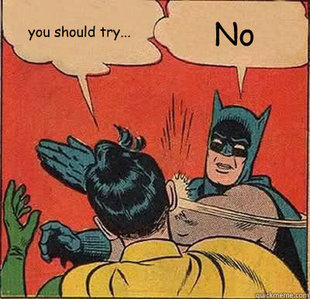
I have found that one of the more difficult things for me to deal with after my diagnosis has been those people who seem to suggest that my illness isn't a big deal, or that I'm being too dramatic, or that a simple cure would fix me right up.  The lupus itself, at times, makes me feel weak, not good enough, defeated.  And when people underscore some of those messages (well-intentioned or not), I have surprised even myself at just how strongly I want to slap them.  (I have -- at least up to the time of this writing -- been able to resist.)


http://31.media.tumblr.com/1fafaba36f4d20ebf3af873249a30ebf/tumblr_mm8ezmmtU61rkabymo4_400.jpg
Pictures taken from Chronic Illness Memes
Bottom line, I don't want to be one of those people to anyone else.  The last thing I want to do with what I hope will be a somewhat positive reflection in my posts on this illness is to, in any way, lessen the value or the great weight of anyone else's experience. 

So, to do justice to myself and all the others out there who struggle with ailments that limit our bodies or our minds in frustrating, seemingly-unbreakable chains, I also want to offer a vulnerable glimpse into the dark, cloudy, stormy side.

I try to be positive and upbeat.  I try to think about things optimistically. 

But I also want to be honest.  While I do spend a lot of time looking on the bright side of having a chronic illness -- there IS a bright side, I think -- it's not all sunshine.  And it's easier to talk sunshine than to live it.  Let's all acknowledge that up front.

I need to also acknowledge: Receiving the diagnosis of an incurable illness is no easy thing.  And coping with ongoing unpredictable sickness gets hard fast. 

There are minutes, hours, days of despair.  When I lay in bed consumed in a million different ways.

I have been weary.  In some moments, hopeless.  I have felt like a victim.  I have cried angry tears and shouted angry demands.  Though more of them have been desperate than mad. 

I have pumped clenched fists in the air and stomped my feet.  (My husband laughs when I do this, and we have proven -- more than once -- that his amusement doesn't lighten my mood.)

I have worried and fretted and tried to wring anxiety out of my hands as I've wondered what this symptom or that one will mean for me.  How bad it will get, how long it will last.  What it will lead to. 

I have whined and moaned and wept.

I have prayed and begged for relief.  Sometimes it came blessedly and gloriously.  Sometimes it came much later than I wanted.  In some ways it has yet to come at all.

Sometimes my determination for the day -- with brow furrowed -- is just making it back to my bed at night.  And anything or anyone who may put up any tiny extra obstacle in my way would face the full wrath I felt at not being well.

There are times when my goals atrophy to one: just make it through.

I have bad times. 

But I also still have plenty PLENTY of good times too.  And if there's one thing I've learned from the bad times, it's that I should treasure the good times even more.

And so, when I talk about this blessing or that blessing in upcoming posts.  When I talk about improvements and advances and being better off in ways, I don't want you to hold up some polished account of a muddy reality and feel less than.  This is hard stuff.  For anyone.  And we all come with our own experiences and our own lenses and our own set of strengths and limitations. 

The thing about lupus, and really life in general, is that no one is stronger or weaker.  No one is ahead or behind.  We all have our burdens to bear and no one but Jesus knows any better way of getting through rough days than the way we manage to get through them.


There's always going to be bad stuff out there.  But here's the amazing thing: light trumps darkness, every time.
-Jodi Picoult
---

This post is part of a series on how lupus has affected me.

Click on the links below to read more:

Part 1: Introduction, The horrific mystery disease

Part 3: How lupus made me a better wife

Part 4: A practice of patience

Part 5: More on the pit

Part 6: Exhaustion

Part 7: Saying no

My diagnosis

My herbalist and the treatment option I am choosing right now

My recent lifestyle changes

To learn more about lupus, you may visit the Lupus Foundation of America.

Thursday, May 1, 2014

Having lupus, Part 1: The horrific mystery disease

Do you feel pooped? Do you occasionally get piercing headaches behind your right eye? Do you bore your friends to death by going on and on and on about how much work you have to do? And have you been so rushed and run down that your personal grooming and general appearance have deteriorated to the point where your friends politely avert their eyes when you enter a room? The good news is there are only two possible explanations for these alarming symptoms: You have contracted a horrific mystery disease for which there is no possible cure or, and this is only marginally better, you are one of those people who are simply doing way too much.

- Bradley Trevor Greive, The book for people who do too much

Johnie and I were at a bed and breakfast in Bloomington celebrating seven years of marriage.  I wandered down to the library and found on the bookshelf a little hardback entitled The book for people who do too much. 

I had planned this particular anniversary celebration with rest and relaxation in mind.  I had felt stretched thin for months.  I craved down time.  Obviously, the book caught my attention. 

I could tell it was going to be filled with wit and sarcasm, but when I came across the quote above in the early pages, it took me a few minutes to muster any laughter.  I do have all those symptoms -- and more.  But my problem is the first one.  In a very real sense.  Lupus is often called the cruel mystery.  The book actually wasn't for me after all.

Adjusting to a lupus diagnosis has not been easy.  In fact, I still have trouble accepting it. 

"Maybe he'll tell me he's decided I don't have lupus," I told Johnie on the way to my most recent appointment with my rheumatologist.  And as we chatted, I hedged the subject with Dr. Lewis.  He wasn't expressing any doubt in my diagnosis.  So I finally said, "I'm having trouble accepting this.  I keep hoping you'll say maybe I don't have it."

He just nodded sympathetically.  Perfect opportunity and he didn't take it.

I am not sure if it was the lupus diagnosis, the other issues I was dealing with when I received the news or a combination of it all, but I feel like I am a completely different person than I was a year ago.

In many ways better, and in some ways maybe not.

After a sarcastic conversation about my current condition a friend sent an e-mail asking: Seriously, how are you doing?

I hadn't yet actually put into words how I was doing.  I told him I felt like there had been a fundamental shift deep inside me as a person and that I was still adjusting.  I told him I was thankful for having what I think is a better perspective on life and for being able to appreciate things I took for granted before.

Like the mornings that I wake up and don't feel sick.

Like being able to walk without my muscles aching.

Like having the energy to cook and, yes, even to clean.

Like going a full month without a migraine.

Being able to wear contacts.

Having energy after 3 pm, or after going to the grocery store.

Being able to think clearly.

Being with friends and family, going on a date, seeing plans through and not feeling sick.

Not having painful, ugly spots on my face.

And on and on...

I am still getting used to this new skin I feel like I'm living in.  My knee-jerk reaction to the diagnosis was to hold on to the parts of me that I valued.  In the "I have lupus" conversation with my college roommate, I assured her (and myself) that I would not change the important things.  I would still love and celebrate food.  I would still hike the mountains of my home.  I would still laugh and joke and feel emotions dramatically. 

But, I feel like every corner and crevice of my life has been touched.  I feel much less determined to hang on to the things that made up the old me.  And as I reflect on the changes, I thought it might be appropriate to take the month of May -- Lupus Awareness Month -- to share these first steps of my personal journey with chronic auto-immune disease. 

May you find hope, encouragement, revelation or companionship on your journey.


---


This post is the first in a series on how lupus has affected me.

Click on the links below to read more:

Part 2: The bad times

Part 3: How lupus made me a better wife

Part 4: A practice of patience

Part 5: More on the pit

Part 6: Exhaustion

Part 7: Saying no

My diagnosis

My herbalist and the treatment option I am choosing right now

My recent lifestyle changes

To learn more about lupus, you may visit the Lupus Foundation of America.

Wednesday, April 23, 2014

Quitting and Moving

Now I've learned, the hard way, that some poems don't rhyme, and some stories don't have a clear beginning, middle and end.  Life is about not knowing, having to change, taking the moment and making the best of it, without knowing what's going to happen next.  Delicious ambiguity.
-Gilda Radner

Three years ago I was desperately homesick and an opportunity opened up for Johnie and me to move back to Kentucky.  It would mean leaving his family, leaving our Kansas friends and Johnie leaving a comfortable, fulfilling, rewarding, enjoyable job.

Thinking about the sacrifice involved made me physically ill.  I was afraid it would be a decision we would end up regretting. 

But Johnie assured me he had weighed the options and was confident we should move despite those we would be leaving, despite the career and financial risks involved.

I wasn't certain we made the right decision until I was blessed with the privilege of living close to my grandfather in his final days.  I had two years of memories we couldn't have made from Kansas.  And I had sweet, sweet final moments that were so much easier because we lived nearby. 

I know a lot of people have gone through a lot more than I have, but it has been a hard year.  Struggling with sickness for months and months before getting any meaningful relief.  Then learning that sickness is not something to tackle or beat, but to manage and adjust to.  Then saying goodbye to the man who had always provided shelter through life's storms. 

I'm still adjusting but I'm already changed.

I have trouble accepting the lupus diagnosis.  (To put it mildly.)  I would prefer to pretend that it doesn't actually exist.  But it won't be ignored.

A few years ago, I gave no thought to the repercussions of my lifestyle on my body.  I did work that I loved and spent time with people I loved.  My days were filled with productivity and laughter and diversions -- morning to night.  I would push through illness, push through tiredness, push through whatever.

But lupus isn't something that can be pushed through.  I tried.  It limits my body, my mind and my time in inescapable ways.

Though it has chained me down, it has also freed me.  While waiting in bed to feel better, life's priorities come more clearly into focus.  Time and energy are worth more.  A good day is more meaningful.  After weeks and weeks of feeling sick, waking up one blessed random Wednesday morning and feeling like my "old self" again is a gift. 

I do not believe I can accurately convey the joy I feel on those days when my health is fully restored.  I feel like running and jumping.  (I refrain from doing either.)  I have never done a cartwheel or a backflip in my life, but the way I feel must be the way one feels seconds before leaping and tumbling in the air.  Those who have suffered from prolonged illness without any relief could probably imagine how wonderful it would feel to be completely healthy again.

But if it is a random Wednesday, I am scheduled to go to work.  And I've already used up all my time off for being sick (and taking a couple trips).  And I feel like I have missed my chance to hike, to savor every delicious bite of food, to be fully present, fully myself with family and friends.  Sometimes the good days come on the weekend.  Sometimes they don't.

And when those days are at a premium, it is hard to spend them in a lackluster way.   

I love my job.  I can't explain that either.  It doesn't even make sense to me, so I can't make it make sense to other people.  I just love it.  It is rewarding to me on many different levels.  I am one of the few people in the world who loves speech writing above any other vocation and who also has the blessing to write speeches in exchange for money. 

In a better world, I would have enough energy to be the wife, the daughter, the sister, the aunt, the friend, the person I want to be and the writer I want to be at work.  Maybe in another time or in another way I will be able to someday.  I hope that is the case.  But for now, I feel like I must choose.  I feel like on most days I only have a shot at one.

And I have learned well that people, loved ones, relationships are more important than any job could ever be.  I do not want to choose, but if I must I choose quality time with my husband, my family, my friends.  It is a stupid career move, but I have decided to do it anyway.  I have also learned well that stupid career moves sometimes turn out wonderfully.

I am blessed to have the option of leaving a job with no other one lined up.  And Johnie and I are also blessed to have the flexibility to move even closer to friends and family I hope to spend many good days with. 

And so...

With a bundle of emotions, I am quitting my job at the end of this month and we are moving to London, KY, where I plan to sleep more and play more.  And maybe someday write professionally again.

We'll see what the future holds.

Friday, March 21, 2014

An open letter to my critics

Dear Critic,

All of my life you have kept me in chains.  Even before I knew what to call you, you kept me silent.  On the sidelines.

I listened to you.  I believed you.

I labeled you truth and anything else a lie.  I don't understand why.  But I did.  And still sometimes do.

You said I was not good enough.  Never would be.  You said there was no use in trying.  That failure was guaranteed.  I agreed.

You said I was stupid.  I was awkward and boring.  I was ugly and fat and unfixable.  Sub-par.

You said my ideas were dumb.  My dreams were invalid.  My words were best unwritten.

I thought you were right.  And so I didn't write them.  When I did pick up the pen, it was with a shaky, unsure hand.

You have judged me harshly without even knowing me.  You claim to understand, but you have no idea.  You don't care about me, truly, even when you say you do.  You're much more insecure than I am and you won't even admit it.  You think the only way to build yourself up is to tear me down.  And that's sad.  I'm not going to play along.

I have tried to make you happy.  Sacrificing my own joy in trying.  With no reward.  (Why am I surprised?)  It must be impossible to please you.

I am learning that you cannot be trusted.  And I am timid and I am still scared of you, but I do not value your opinion of me like I used to.

I have let you hold me back, but now I am breaking free.  You will not defeat me.  If I fail, it will not be because of you or your accusations or your predictions.  And when I am wrong, that still does not mean that you are right.

Even if I sometimes stumble, even if my words fall flat, even if a dream is unrealized, you still are mistaken about me.

Despite what you say, there is not fault in boldness, in authenticity, in courage, in kindness -- even hard kindness, in persistence and perseverance and patience.

Others know better than you about me.  You do not, but others accept me for who I am.  I am loved.  And I am turning my ear to the voice of love.  That is truth.  I am clinging now to love and truth and justice and security and validity.

And as we part, I hope you seek a better way.

Best,
Amy

I do the very best I know how - the very best I can; and I mean to keep doing so until the end. If the end brings me out all right, what is said against me won't amount to anything. If the end brings me out wrong, ten angels swearing I was right would make no difference.
-Abraham Lincoln

Wednesday, March 5, 2014

Criticism reframe

Asking a working writer what he thinks about critics is like asking a lamppost what it feels about dogs.
-John Osborne

I may be the last person in America to know about Divergent.  I mean, I've seen random posts from friends about the book series and Veronica Roth.  But I didn't really know what they were about and didn't take the time to investigate.  I've been a bit pre-occupied these last few months.

I was watching live television Tuesday night and couldn't fast-forward through a movie preview about a girl trying to break free from a society of factions.  I was intrigued.  The movie: Divergent.  The pieces came together.  That's what people have been talking about.

I decided to check out the book series on Amazon.  I wasn't sure if I would like it or not.  Though not a hard and fast rule, I usually don't L-O-V-E love other-worldly-ish science-fiction-y books (which this looked to be).

I decided to scroll through some reader reviews and came across this one:

...The real reason I give this book one star is because the book, as a whole, was awful. I'm sorry, but this is one of the most shoddily written books I've ever read in my entire life. And I say this as someone who absolutely adored the first two books in this series. I say this as someone who read Fifty Shades of Grey ... and Allegiant has officially taken that book's place as the worst book I've ever read. And I debated somewhat on that, but I decided that Allegiant wins because, while Fifty Shades was an affront to literature indeed, I don't actually wish I could go back in time and unread it. I wish to the heavens that I had never read Allegiant. ...

I don't know much about these books, their writer or this reader.  But words like that paralyze me.

They make me think: If a best-selling, publisher-contracted author whose words have been catapulted to the big screen gets reviews like that, then what would people say about the words I write if they read them?

We've been talking about obstacles in the (in)courage writers' group I'm blessed to be a part of and one of my biggest is fear of criticism.  Before I click publish, I begin to imagine how my words might be criticized.  I have more than two dozen un-published drafts in my blog queue.  Many of them stalled out of fear at how they might be received.  For style or for content.

This fear is why I stay silent more than I speak up.  Imagine my struggle when I learned that silence is also criticized!  What can a girl do to banish the critics?!?!

Well, while I do wish we lived in a world where people are nicer to one another.  And I do think we have become an overly-critical people.  (Wait... I'm being critical... This is so hard.)  The truth is, there will always be critics.  Criticism is inevitable.  Even Jesus -- especially Jesus -- was criticized.

And sometimes criticism can be a good thing.  What if Dr. Martin Luther King, Jr. had not been critical?

Maybe the best way is not to avoid criticism, but to work through it.  To work despite it.  To be grounded in my value and my worth (as Alia Boston Hagenbach reminded our writers' group) and my own personal truth and to share those with the world in love.

Maybe the best way is not to avoid criticizing, but to do so with respect and thoughtfulness.  To work to build up and improve, not tear down and destroy.

To remember that the best way to move forward together is to keep a dialogue open to every voice, every side, every ideology.

And to remember when words boomerang back harshly at me that even best-selling, publisher-contracted authors whose words are played out on-screen have their critics.

Just like a harsh judgment doesn't make her any less than, it doesn't make me less than either.